Artist and CS jobs, WTF!

Intro from the Febuary 2026 newsletter:

Hello All,

Here’s a clean proofread version with only necessary corrections for grammar, clarity, and flow. No stylistic rewrites, no added ideas, no unnecessary changes.

Hello All,

Normally, I start with a quick blurb about what’s going on at XOOT. But yesterday I wanted to mention AI… then I fell down the rabbit hole.

Here’s what happened:

For the last 3 years, I’ve skipped around to certain shows (LightBox, GDC, SigGraph, etc.). At all the shows I’d get a bad vibe about employment opportunities for artists, with an underlying sense that AI is a big contributing factor.

That’s the vibe, but what do the statistics say?

I used AI to download data from the U.S. Census Bureau, organize it, and make a graph. The graph for artist employment is basically, “line go up.”

BUT those “stats” do not match what I’m seeing. So, try again.

What about something that’s been more popularized—Computer Science jobs? I asked AI to do the same thing for that. Once again, “line go up.” WTF! I have college-age kids who have graduated or are in technical majors. All the feedback is that CS majors are in an employment graveyard.

I’m confused. I see the immense power of AI to displace jobs, all the personal feedback I get is that Art and CS jobs are hard to come by, but the government statistics seem to imply “don’t worry, be happy.”

Well, I’m already a day late on this newsletter, so I asked AI to post a blog entry with the info on the XOOT website: https://xoot.pro/artist-and-cs-jobs-wtf/ (Feel free to add your comments).

– Chris (XOOT’s Founder)

A note about my AI use for this article: Most of it was done for irony, but AI is making its way into my workflows. XOOT_Pro was invented to improve the economics of interacting with a screen. XOOT (the company) only survives if humans continue to interact with screens. I use AI as a tool for several tasks, but not for artwork. (I’ll table the “training AI with art” tragedy for another day.)

Below is what the AI generated:

1. Digital Artist & Design Trends

Notice the massive restructuring of the “Commercial & Industrial” category in 2024 as digital product designers were finally filtered out of physical product design counts.
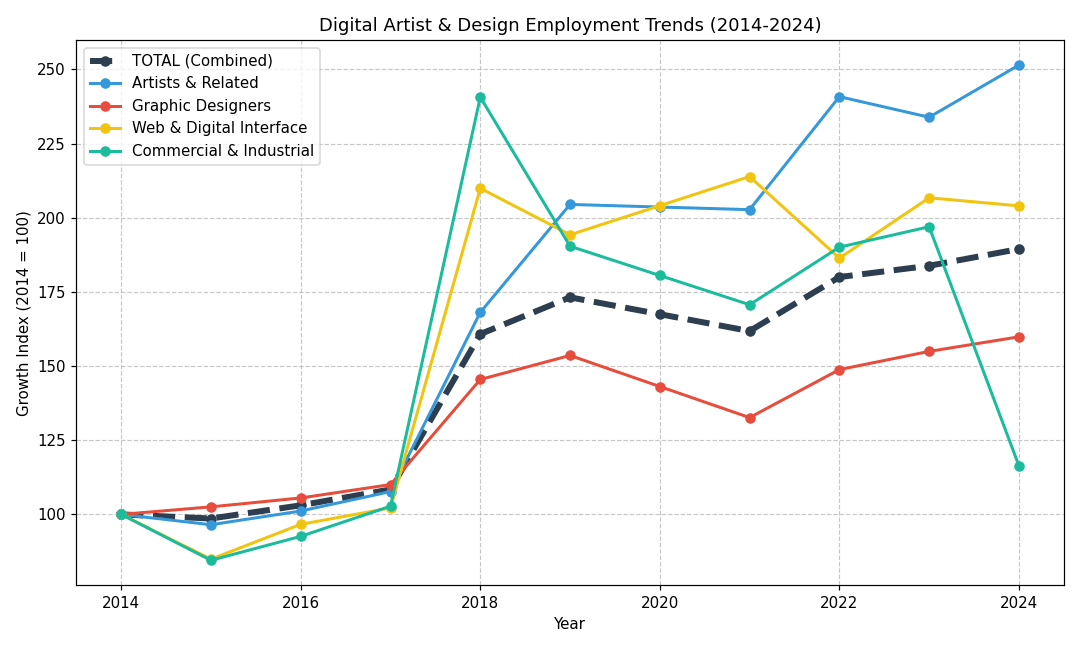
Digital Artist Employment Trends (2014-2024)

Category Definitions

Artists & Related Workers: Professionals creating original visual media, including fine artists, art directors, animators, and special effects artists for film, gaming, and multimedia.

Graphic Designers: Specialists who combine art and technology to communicate ideas visually through layouts, logos, and branding for print and digital platforms.

Web & Digital Interface Designers: Designers focused on user experience, structuring the layout, navigation, and interactive elements of websites, apps, and software.

Commercial & Industrial Designers: Experts who develop concepts for manufactured physical products, balancing aesthetics and functionality for everything from electronics to vehicles.

Detailed Employment Figures

YearArtists & RelatedGraphic DesignersWeb & DigitalCommercial & Indust.Total
201475,160154,00626,0716,580261,817
201572,551157,93222,1415,562258,186
201676,018162,53625,1976,093269,844
201780,941169,49526,6426,762283,840
2018126,347224,06254,73315,836420,978
2019153,698236,51750,64812,528453,391
2020 *153,036220,39453,20511,880438,515
2021152,375204,27055,76211,231423,638
2022181,001229,18948,59412,508471,292
2023175,793238,62953,89712,960481,279
2024189,004246,20153,1887,658496,051

2. Computer Science Trends

Watch the explosion of “Software Developers” directly mirroring the decline of traditional “Computer Programmers.”
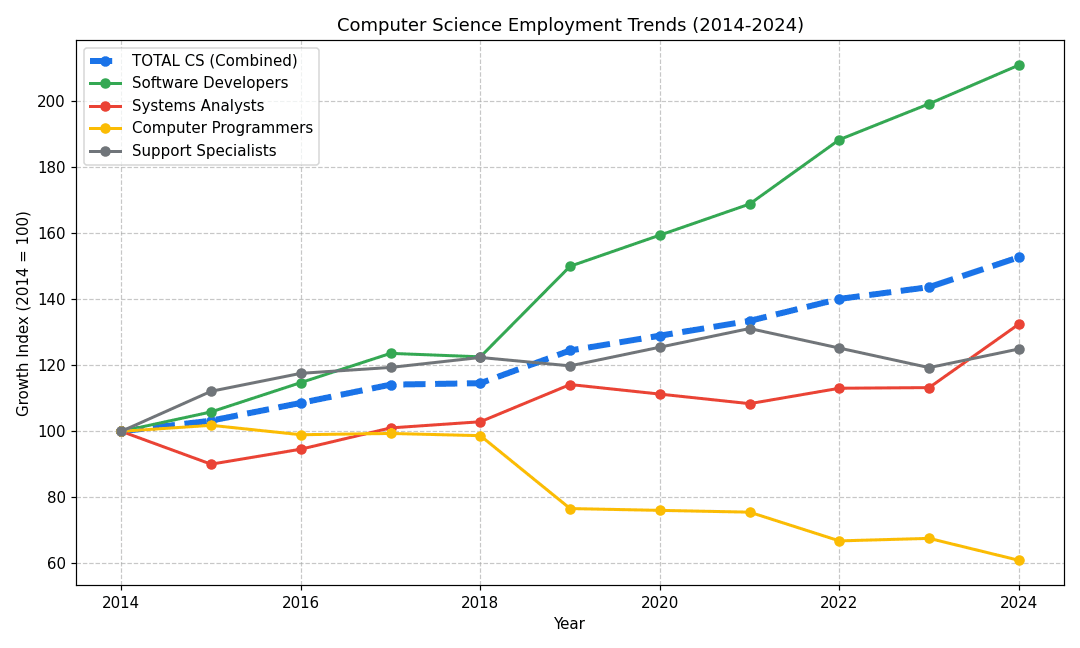
Computer Science Employment Trends (2014-2024)

Category Definitions

Software Developers: Professionals designing and developing applications and computer systems. (Note: Large growth reflects the tech boom and reclassification of many developers out of broader titles.)

Systems Analysts: Specialists who evaluate and design information systems to help businesses operate more efficiently.

Computer Programmers: Traditionally defined as those writing and testing code; this category has seen a decline as the industry shifts titles toward “Developer” or “Engineer.”

Support Specialists: Professionals who provide technical help and advice to users and organizations.

Detailed Employment Figures

YearSoftware DevelopersSystems AnalystsComputer ProgrammersSupport SpecialistsTotal
2014979,815473,960374,346470,9152,299,036
20151,037,453426,775381,192528,0802,373,500
20161,124,661448,325370,512553,7182,497,216
20171,211,419478,879371,952562,1452,624,395
20181,201,088487,730369,439576,3762,634,633
20191,470,133541,210286,721564,3842,862,448
2020 *1,562,514527,464284,681591,0402,965,699
20211,654,896513,719282,641617,6953,068,951
20221,846,122535,886250,047589,7583,221,813
20231,952,628536,798252,895561,8623,304,183
20242,067,580628,053228,024588,4643,512,121

* 2020 estimates are interpolated due to the pandemic interrupting the standard ACS 1-Year release schedule.

here's some more AI output about the data:

  • The data is from: U.S. Census Bureau’s American Community Survey (ACS)
  • (Artist Data) The 2018 Spike: You’ll notice a significant jump in employment numbers between 2017 and 2018. This is because the Standard Occupational Classification (SOC) system was overhauled in 2018, changing how the Census counted certain digital jobs and expanding who qualified as “digital interface designers” and “artists.”
  • (Artist Data) The sharp decline in the “Commercial & Industrial Designers” estimate for 2024 is likely due to the Census Bureau tightening its definition for the category.
  • (CS Data) Computer Programmers: This category has seen a decline of nearly 40%. This doesn’t mean fewer people are coding,
    but rather that “Programmer” is being replaced by “Software Developer” or “Engineer” as the standard professional
    title.
  • The 2020 Data Gap: Because of the pandemic, the Census Bureau did not release standard 1-year estimates for 2020. The graph automatically interpolates (averages) 2019 and 2021 to provide a continuous 10-year trend line.
  • 2025 data should come out in September 2026

My notes about the Data:

I want to trust the government data, but it does not agree with my personal observations.  Yes, the data is stale by a year, but my observations of the two employment categories started back in 2023. It will be interesting to see the 2025 numbers when they come out.

Initially, I tried pulling data from the Bureau of Labor Statistics but it’s blocking AI Agents because of heavy internet traffic.   I can only imagine that requests like mine are flooding the system.

The Furture of Work:

Where does it all end?  The more I use AI and the speed of its getting better… Who knows.  There’s a lot of debate out there on this right now, and my opinions shift daily.  

I don’t want to be too pessimistic or optimistic, but confusing information just keeps me guessing.

If you comment below, I’m interested on hearing your views.


My AI use:

 All the work above was done with GeminiCLI, I’m not endorsing it, it just happens to be “free” right now.  However, I’m impressed!

I also use Anthropic, OpenAI, Moonshot and others. There’s all great depending on your needs and your cost ceiling.

Up until late last year, I’d been primarily using AI like an enhanced Google search.  Then I started experimenting with AI to help with the backend business work for XOOT.  At times, it can be genie-in-a-lamp scary good.  At other times, it’s like herding cats and it just exhausts you to the point where you settle for something sub-par. 

My Previous Blog on AI:

Back in 2022, before XOOT launched, I made a blog about AI.  The AI Art Revolution 2022 

I just re-read it.  (This is before I was educated on the controversy of the use of art for training AI.)  I may have been overly optimistic.

One thing I’m most disappointed in are the AI tools.  I thought there would be more of a close collaboration between you and an AI on approaches to the artwork.  Don’t get me wrong, tools where you don’t even know AI is behind the scenes are great (such as object removal from photos).  

It would be great if tools were more like: you’ll give examples of brush strokes, and how they should be applied.  Then the AI comes back and asks about anatomy and lighting.   The idea would be to go into a dialogue of examples, experiments and exploration.  To help you develop unique styles and approaches. 


Currently, I get how this type of collaboration would be difficult with the mechanics of current AI architectures, but I’m hopeful for more collaborative tools in the future.

Leave a Comment

Your email address will not be published. Required fields are marked *

Shopping Cart
Scroll to Top